Discover the true cost of your everyday prompts with our free, open-source extension.
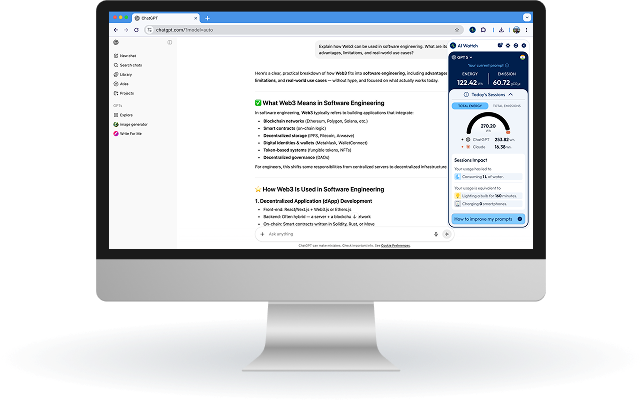
Meet AI Wattch
A browser extension that shows you the environmental impact of your AI use.

Meet AI Wattch
A browser extension that shows you the environmental impact of your AI use.
Explore Features
This compact tool brings you detailed insights and prompt tips to refine your GenAI workflow.

Real-Time Tracking
Get energy and emissions data for every AI prompt, instantly.

Daily Session Insights
See how each interaction affects your cumulative footprint.

15+ AI Model Analysis
Understand your usage across all models of ChatGPT & Claude.

Smart Prompt Recommendations
Get curated tips for efficient prompting and reduce impact.



Sharing energy consumed for an "average conversation" leaves us with more questions than answers: What is the actual carbon footprint of my conversations? Does it even matter? How can I improve my prompts to be more efficient and minimize my impact? We answered those questions with Antarctica.

Pascal Joly
Founder, IT Climate Ed
One-Token Model x AI Wattch
With the One-Token Model at its core, AI Wattch brings you the most reliable insights into your GenAI usage.
The rapid proliferation of Generative AI has reshaped both our digital and physical environments. By 2025, we have moved well beyond the “hype cycle” into an era of mass adoption in which AI is embedded into everyday workflows, acting simultaneously as a personal assistant, creative partner, and professional co-pilot. This ubiquity drives unprecedented demand for compute, which begins even before a single prompt is written.
The embodied emissions, and water consumption from manufacturing specialized GPUs, as well as constructing and maintaining AI data centers, already make up an estimated 30% or more of a model’s total life-cycle footprint, a proportion that continues to grow as model sizes, hardware complexity, and rebound effects increase. The remainder stems from operational energy consumption, during training and, increasingly, inference.
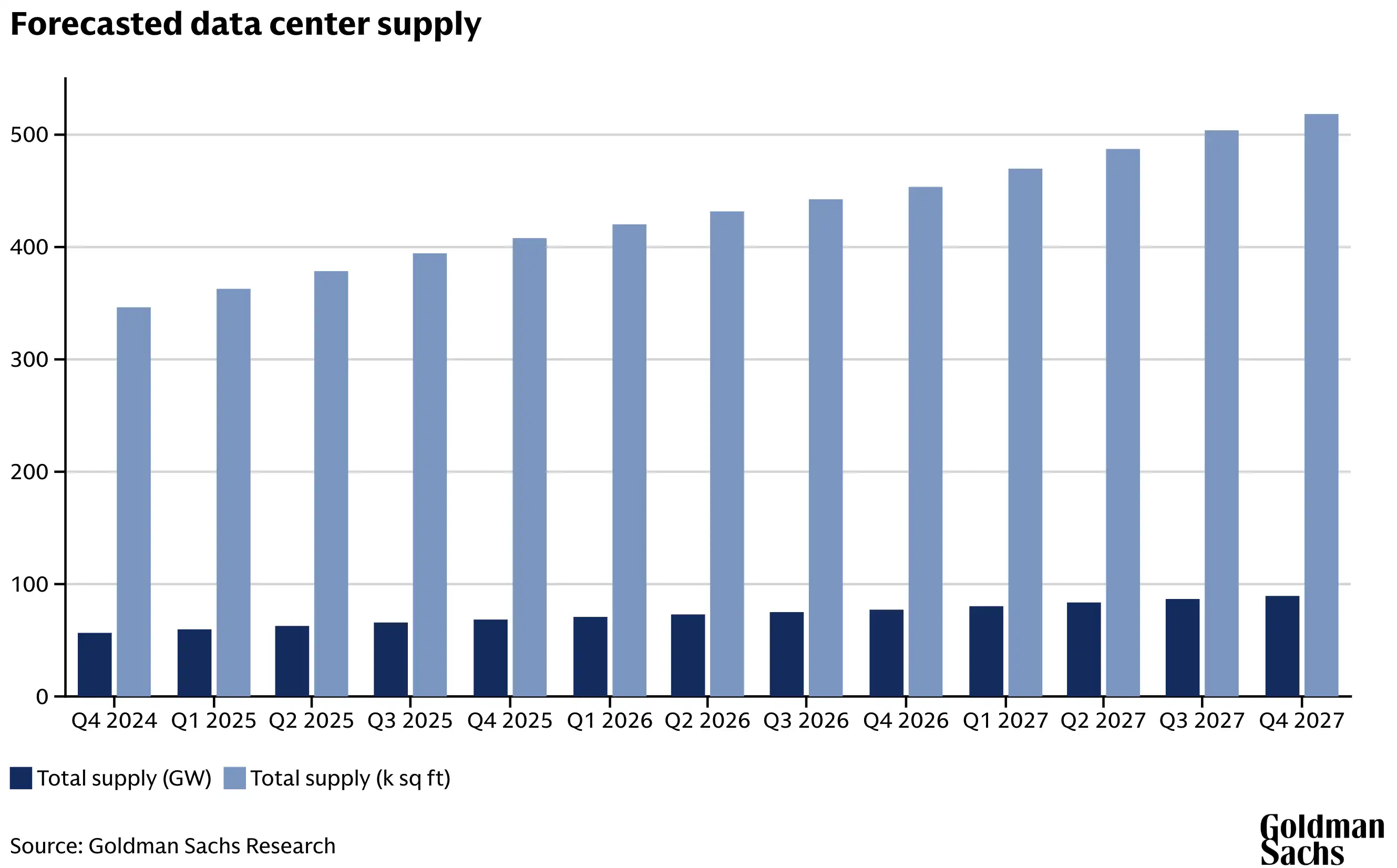
Source: (Goldman Sachs)
While model training remains a singular and energy-intensive milestone, the inference phase, where models are actively used by millions of people daily is becoming the dominant driver of AI's carbon footprint. As of 2025, this usage by end-users across LLMs such as ChatGPT, Claude, and Gemini, for tasks ranging from creative writing to complex coding, accounts for a dominant and growing share of the AI lifecycle's carbon footprint. The energy demands of generative AI are expected to continue increasing dramatically over the next decade.
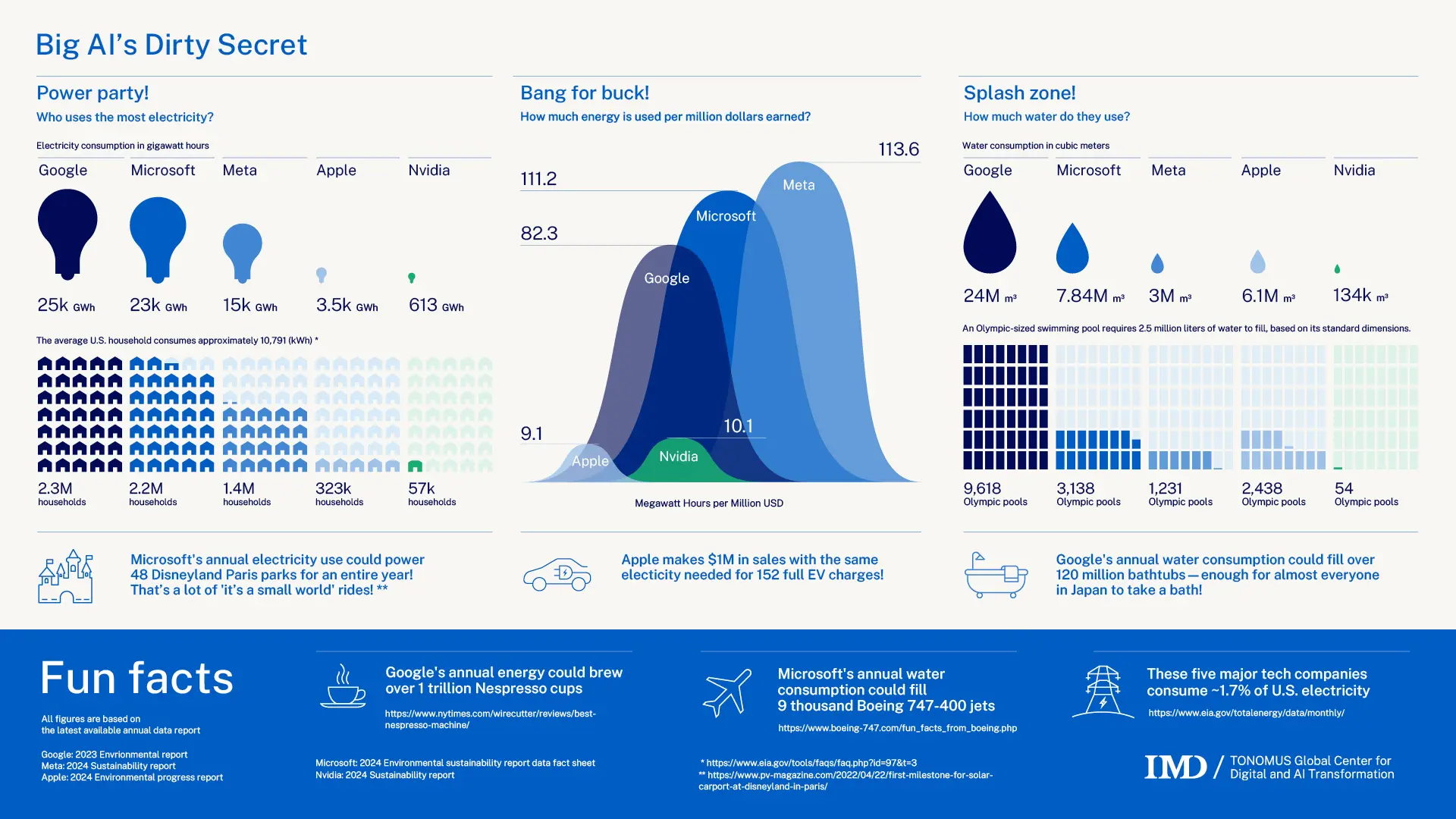
Source: (IMD)
If the world's 9 billion daily search queries on Google were to shift entirely to Gen-AI, it would require an additional 10 terawatt-hours of electricity annually, equivalent to the consumption of 1.5 million European citizens. Moreover, running an inference session of just 20–50 queries consumes approximately 500 ml of water, a standard water bottle's worth of resource depletion for a brief conversation. (Capgemini)
| Provider | Reported Token Volume (Monthly, 2025) |
|---|---|
 Google (Gemini / DeepMind) Google (Gemini / DeepMind) | 1.3 Quadrillion (1.3 x 10¹⁵) |
 OpenAI (API + ChatGPT) OpenAI (API + ChatGPT) | >259 Trillion (API only) |
 Microsoft (Azure OpenAI/Copilot) Microsoft (Azure OpenAI/Copilot) | 1.7 Trillion (Foundry product) |
 Anthropic (Claude) Anthropic (Claude) | ~25 Trillion (estimated) |
Yet this resource consumption remains invisible to the end-user. AI systems abstract away their material footprint, creating a disconnect between digital behavior and environmental consequence.
Compounding this opacity, the world’s major AI providers: OpenAI, Google, Microsoft, Anthropic, Meta, and others release only annual, company-wide sustainability figures that obscure real-time operational impacts. Market-based accounting techniques such as PPAs and RECs further distort the relationship between actual energy use and reported emissions. Even when per-query numbers are published, they rely on median estimates (Google), masking the variability introduced by model routing, hardware type, and regional grid conditions.
This black-box dynamic becomes even deeper at the inference level. When a user sends a prompt to ChatGPT, they have no visibility into where the request is processed, what hardware is used, how many tokens the model generated, or how carbon-intensive the local grid was at that moment. Without this granularity, meaningful user-level optimization remains impossible.
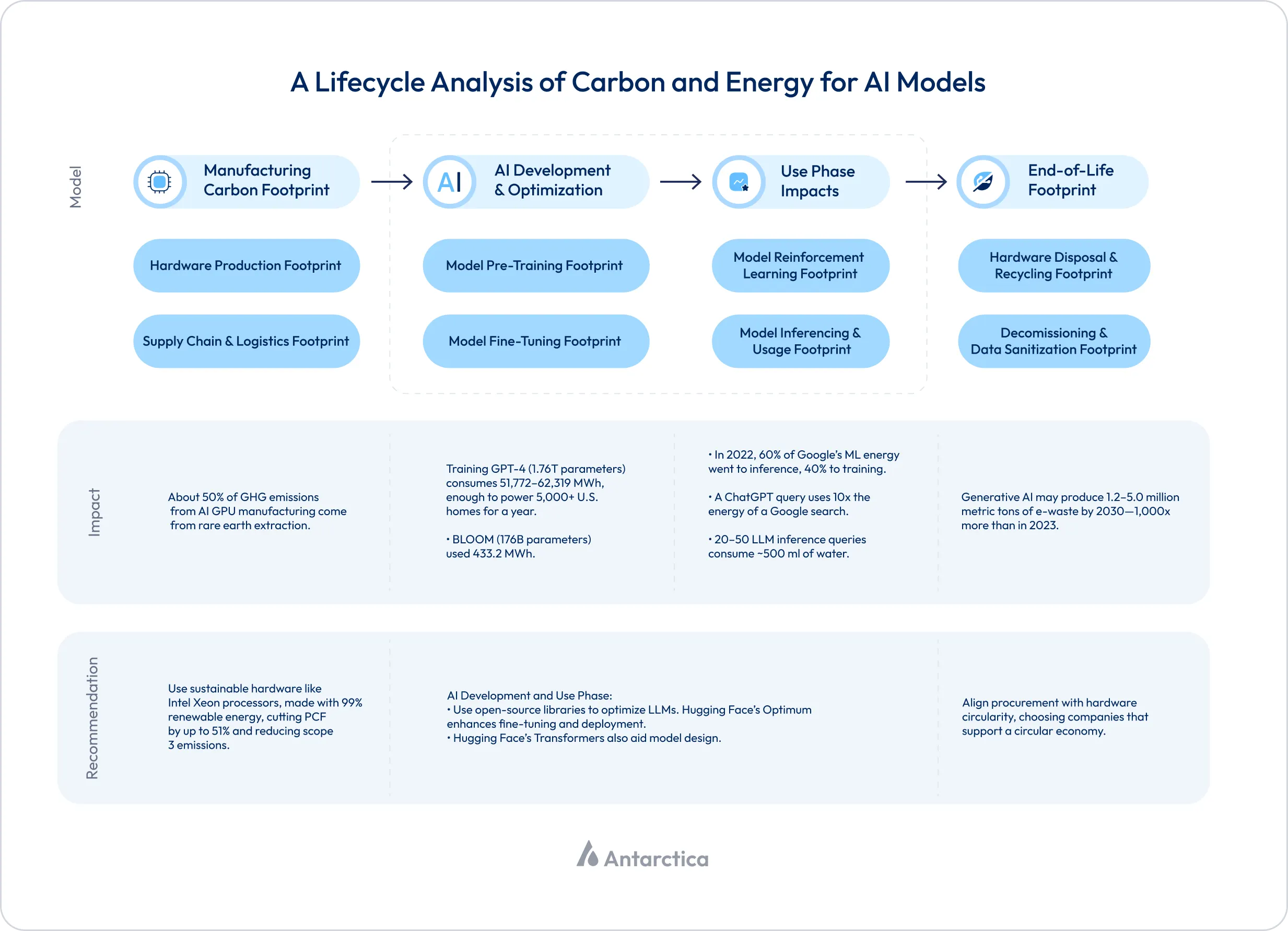
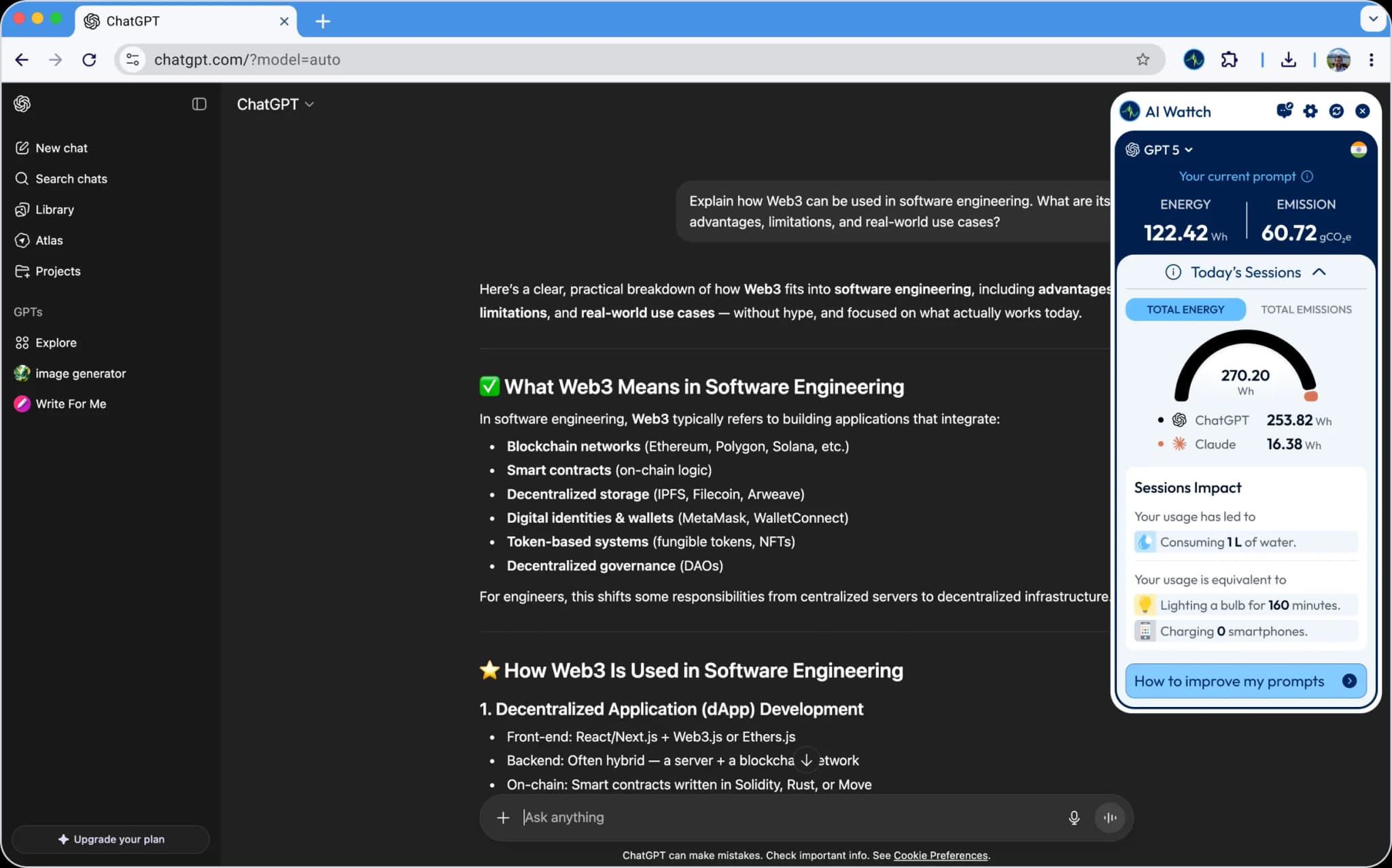
Developed as an application of Antarctica’s One Token Model, AI Wattch is designed to move beyond opacity and provide real-time, user-level visibility into the environmental cost of generative AI. Although individual emissions per query may appear small, optimizing the energy footprint of LLM usage, when multiplied across billions of daily interactions, can drive system-level reductions at meaningful scale.
AI Wattch v2.0 operationalizes this insight by treating the token as the atomic unit of environmental cost.
The extension synthesizes:
This enables a level of measurement precision that has historically been unavailable to end-users. More importantly, AI Wattch couples this measurement with behavioral science–driven prompt optimization recommendations, providing the user of AI Wattch an actionable toolkit to ensure sustainable Gen-AI use.
AI Wattch began with a simple but urgent premise: give the everyday AI user direct visibility into the environmental cost of their digital actions. Version 1, created by Pascal Joly (IT Climate Ed), established this foundation. It introduced one of the world’s first browser-based calculators for the energy and emissions associated with LLM usage, an unprecedented step toward democratizing sustainability insights for AI.
AI Wattch v1 was built at a time when LLMs were comparatively smaller, inference pipelines were predictable, and the industry was operating on a narrower set of hardware configurations. As generative AI accelerated through 2025, this stability disappeared.
Model architectures diversified, from Mixture-of-Experts to long-context reasoning models, while GPU generations evolved rapidly and providers began deploying heterogeneous clusters with highly variable power profiles. Token generation speeds, active parameter counts, quantization strategies, and memory allocations all shifted at a pace that quickly outgrew V1’s static assumptions. A methodology built around a single GPU type, fixed utilization, and fixed token energy factors could no longer represent the reality of modern inference. AI Wattch v2.0 was therefore designed to be dynamic,capable of absorbing continuous changes in models, providers, hardware, and user behavior.
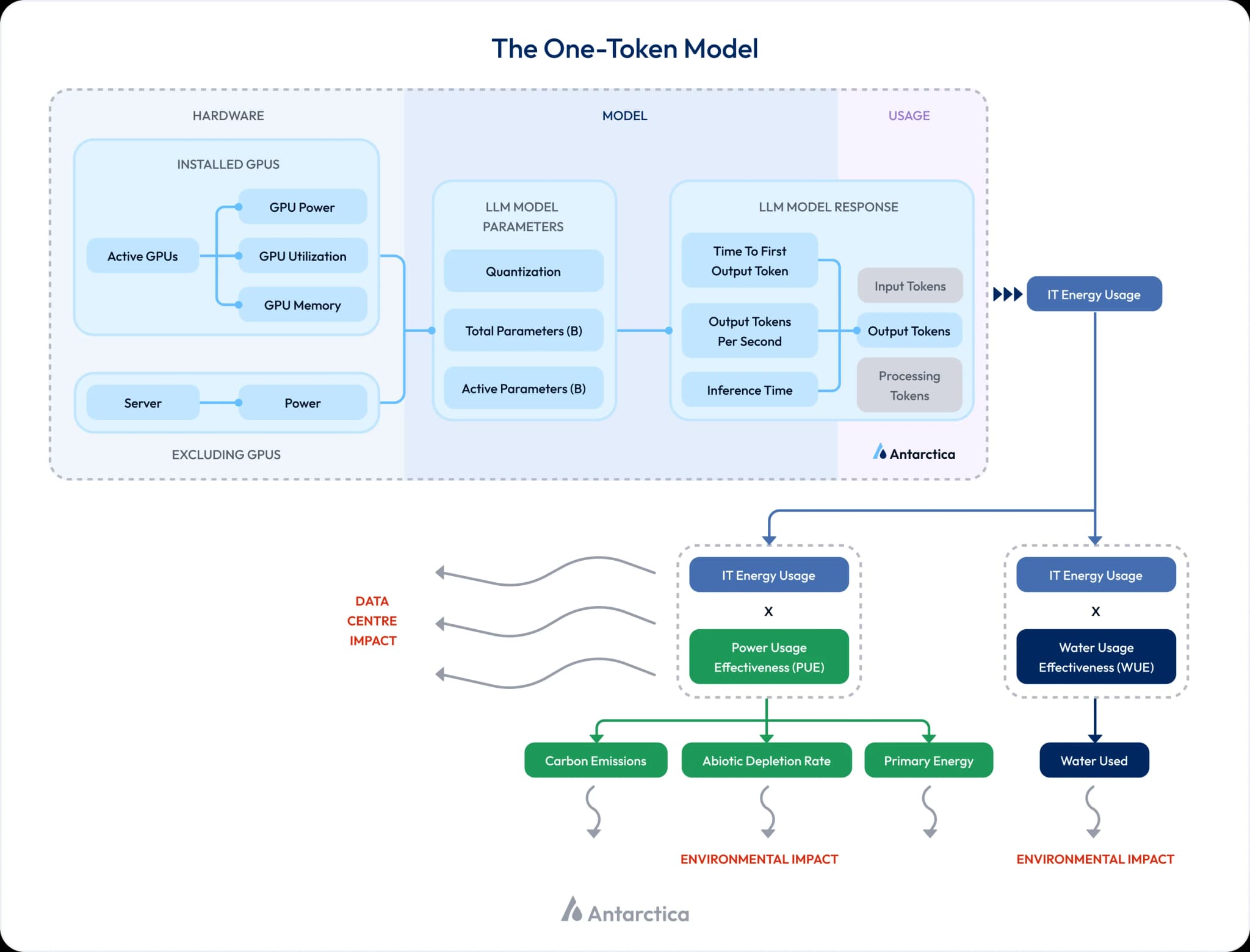
AI Wattch v2.0 represents a complete architectural redesign of the extension, moving from a monolithic, assumption-driven model to a modular, dynamic, and scientifically grounded emissions estimation system.
The architecture is built around three interacting layers:
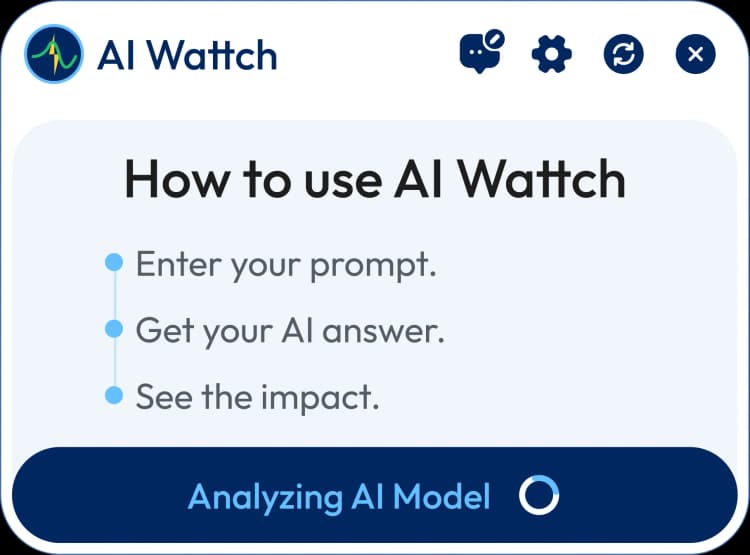
1. Telemetry Capture Layer (Browser-Level Observability)
AI Wattch captures real-time usage telemetry directly within the browser (both Chrome, and Firefox), without logging content or accessing private user data.
Key telemetry inputs include:
Supports:


2. Inference Modeling Engine
This is the scientific core of AI Wattch v2.0. By applying the One-Token Model, it combines real-time telemetry with statistical, architectural, and hardware-derived models to compute energy, carbon, and water estimates.
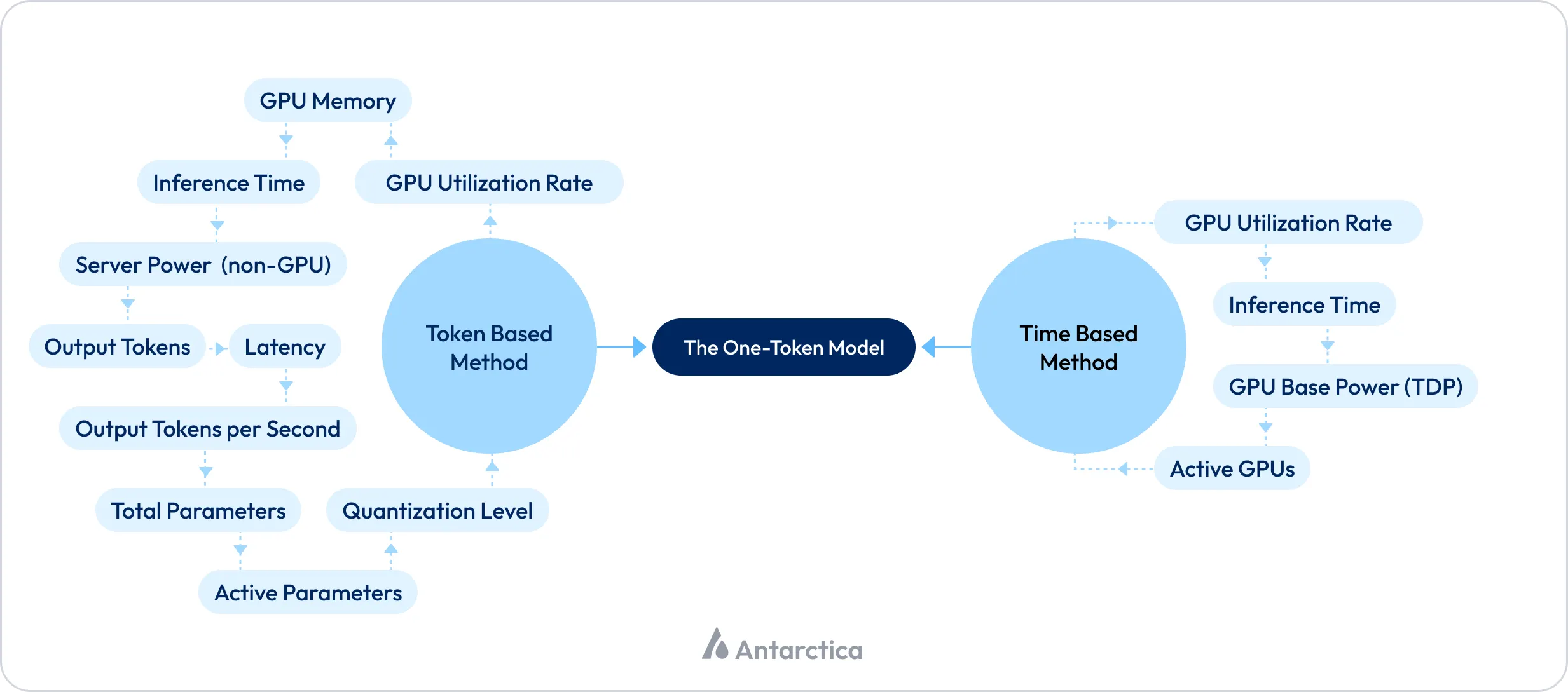
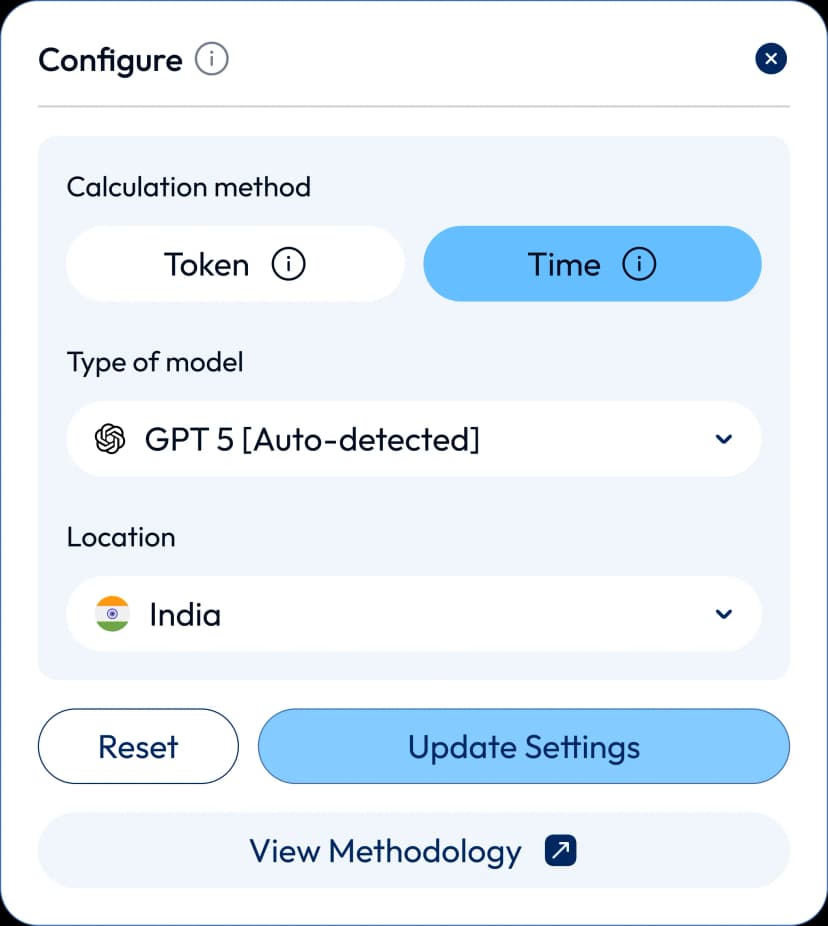
Hybrid Methodology: Token and Time Methods
A key motivation for this upgrade was the growing disconnect between how major AI providers publish sustainability metrics and how AI is actually used in practice. For example, Google’s public methodology for Gemini reports per-query emissions using static median prompt assumptions, a hypothetical “average” prompt size. While useful for high-level reporting, this abstraction masks the reality that AI usage is not homogenous.
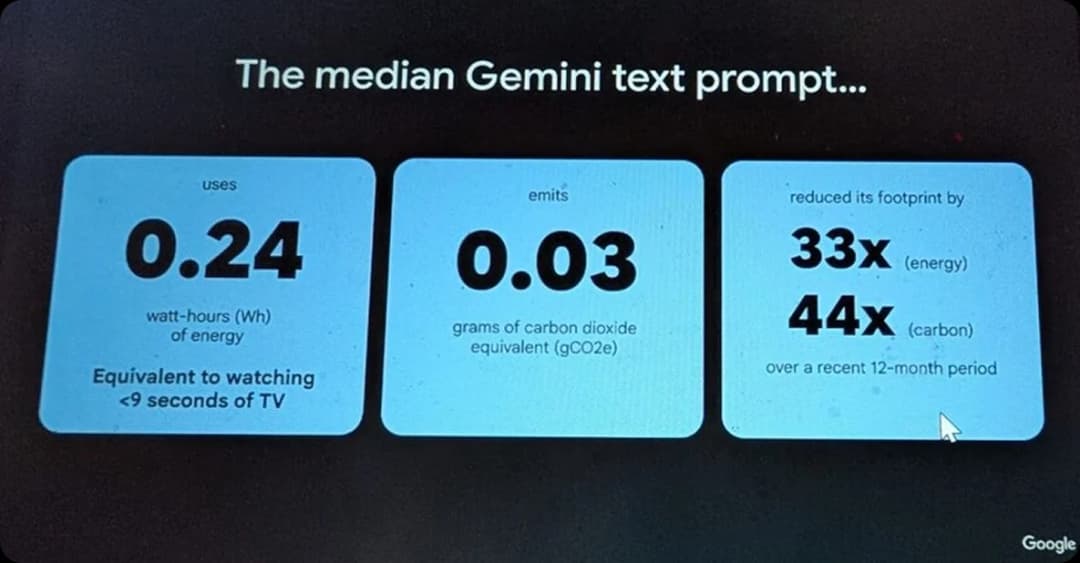
Users engage in a blend of reasoning and non-reasoning tasks, long-context and short-context exchanges, and multimodal interactions involving text, images, and audio. Each of these tasks produces vastly different tokens. A simple two-sentence query may require minimal GPU activation, while a multi-step reasoning prompt, an image captioning task, or a code analysis requires significantly more inference time.
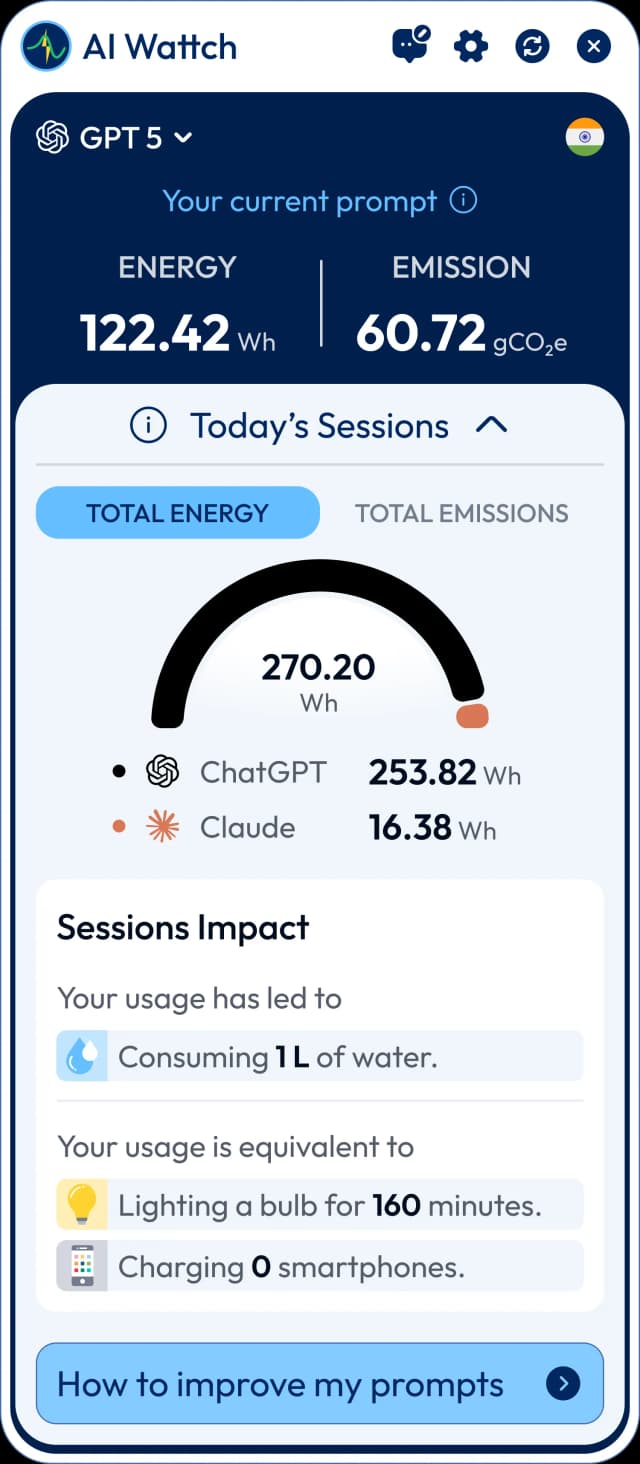
AI Wattch takes into account 3 scenarios:
Hardware and Model Specificity
AI Wattch uses Antarctica’s comprehensive database of GPU profiles, each mapped to its distinct features, memory bandwidth, and model-specific inference characteristics. It accounts for quantization, context length, and active parameter selections. This allows AI Wattch to be aligned with real-world LLM behavior.
Region-Aware Energy Modeling
AI Wattch v2.0 maps each session to a geographic energy context, via user-selected region or optional IP-based detection and uses corresponding grid carbon intensity and PUE values to compute emissions. A request to the same model may generate dramatically different emissions in Singapore, Paris, Ohio, or Mumbai. This shift enables emissions estimates that reflect where computation is actually occurring.
Water Usage
AI Wattch v2.0 introduces water usage as an increasingly critical metric in AI sustainability. The engine uses a water-footprint formula that connects energy consumption (derived via the One Token Model) to both on-site and off-site water usage.
Multi-Provider
Today’s users frequently switch between Claude, Gemini, Perplexity, and multiple versions of GPT models. Each platform behaves differently, generates tokens differently, and is hosted on different hardware. AI Wattch v2.0 includes multi-chatbot, multi-model support, enabling consistent, comparable measurement across the AI tools people actually use.
AI Wattch v2.0 supports:

Supported Models
| Provider | Model Name |
|---|---|
| Open AI | GPT-5 |
| Open AI | GPT-5.1 |
| Open AI | GPT-4 |
| Open AI | GPT-4o |
| Open AI | GPT-4o mini |
| Open AI | GPT-4.1 mini |
| Open AI | GPT-4.1 |
| Open AI | GPT-5.2 |
 Anthropic Anthropic | Claude Opus 3 |
| Anthropic | Claude Opus 4 |
| Anthropic | Claude Opus 4.1 |
| Anthropic | Claude Opus 4.5 |
| Anthropic | Claude Haiku 3.5 |
| Anthropic | Claude Haiku 4.5 |
| Anthropic | Claude Sonnet 3.7 |
| Anthropic | Claude Sonnet 4 |
| Anthropic | Claude Sonnet 4.5 |
3. Awareness & Optimization Layer
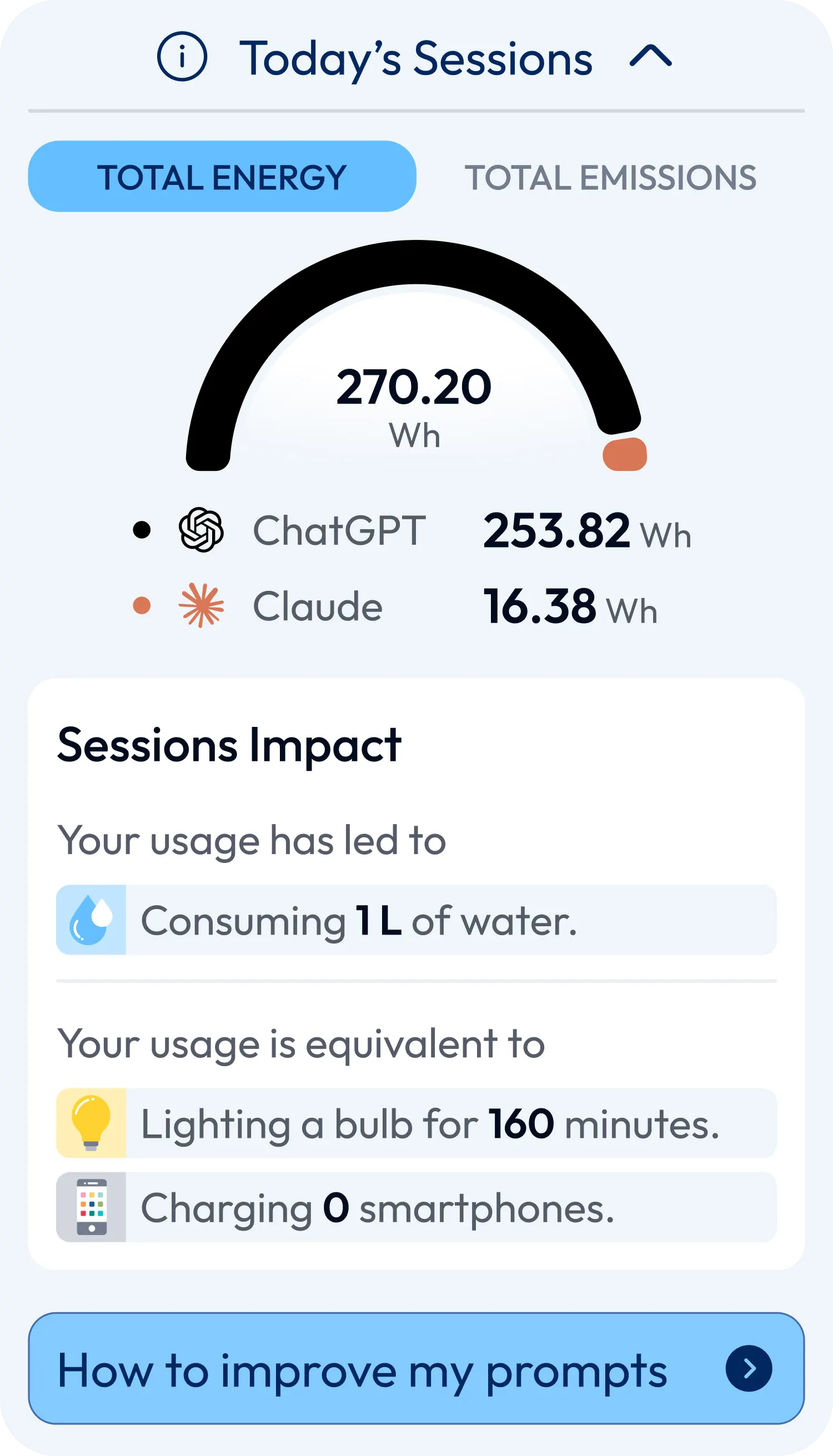
AI Wattch v2.0 is designed to make environmental impact immediately understandable and actionable for the user. Each query triggers a real-time panel that displays its estimated energy, carbon, and water footprint, paired with simple, easy to understand equivalencies: such as minutes of lighting a bulb or charging a smartphone, to anchor the numbers in everyday terms.
Over time, users can track their cumulative daily impact, observe patterns in their querying behavior, and compare how different models: GPT-5.1 versus Claude Opus 4 or GPT-5 versus GPT 5.1, produce varying environmental profiles for similar tasks. This comparative layer not only empowers informed model choice but also reveals how architectural differences across LLMs manifest in real-world emissions.
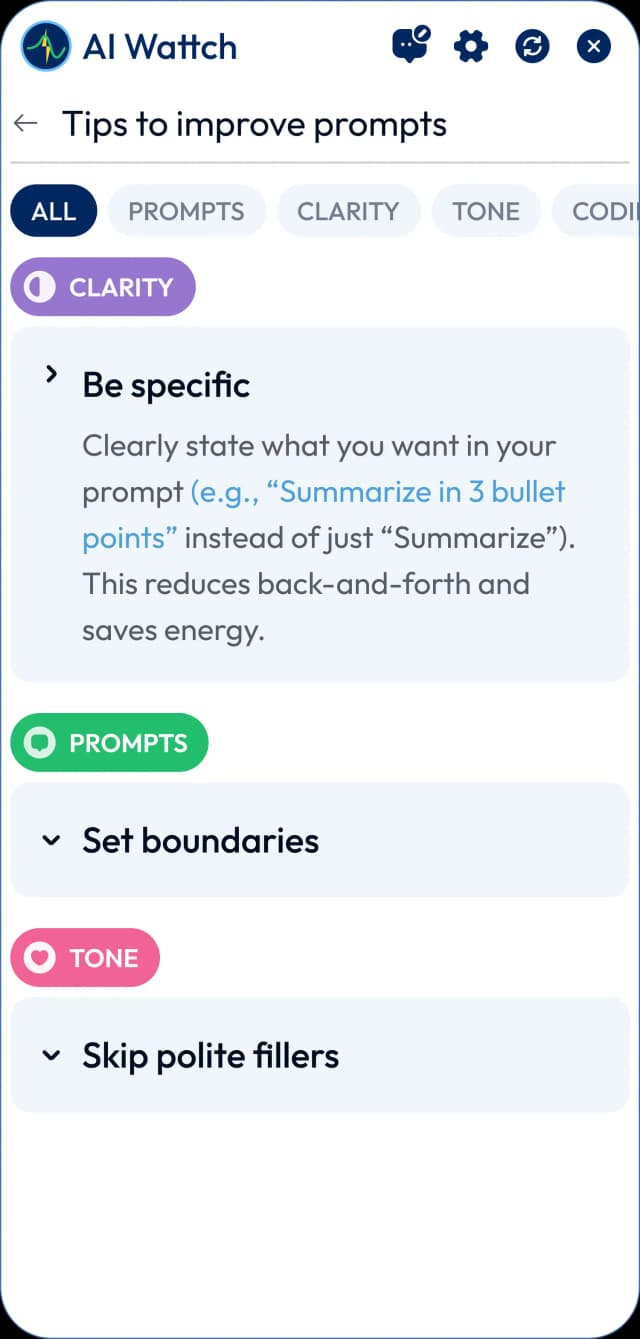
Beyond visualizing impact, AI Wattch v2.0 includes a Prompting Optimization Framework that helps users reduce their AI footprint without changing their workflow. Instead of interpreting prompt content, the system relies only on metadata: token counts, prompt length, output size, and interaction sequence, to classify queries into categories like analysis, search, drafting, or generation.
Each category has known computational tendencies, allowing the system to offer small, targeted suggestions such as consolidating instructions, narrowing a query, or batching related questions. These “green nudges” are grounded in behavioral science: they reduce friction, avoid disruption, and help users adopt more efficient prompting habits over time. The result is a UI that not only reports environmental impact but actively supports more sustainable AI usage in a lightweight, privacy-preserving way.
AI Wattch v2.0 is open-source and engineered with a privacy-by-design framework that aligns with global data protection standards, including GDPR, CCPA, and the core principles of data minimization, purpose limitation, and local processing.
AI Wattch v2.0 lays the groundwork for a solution that will continue to grow as AI models, hardware, and environmental datasets evolve and expand into longer reasoning, richer multimodal capabilities, and more complex workflows.
A key priority is the continuous expansion of supported models and platforms. As OpenAI, Anthropic, Google, Meta, and open-source communities release new LLMs, vision models, audio models, and agentic systems, AI Wattch can integrate them seamlessly, owing to its modular architecture. Users will be able to compare their environmental impact across all LLMs using one consistent tool. The goal is to make AI Wattch model-agnostic.
To improve accuracy, Antarctica will notably continue to grow its database of hardware and cloud infrastructure. Providers increasingly use different GPUs and accelerators depending on region, load, and model size. As more public data becomes available, AI Wattch will incorporate better information about which chips are being used, how efficient they are, and how cloud providers in different regions run their data centers. Over time, this will allow users to see not just how much energy a given prompt uses, but also how that might differ when routed through the US, Europe or Asia.
Environmental impact measurement will broaden as well. Today, AI Wattch focuses on carbon and water. Future versions will consider additional factors such as embodied emissions from hardware manufacturing, resource depletion, and other indicators that matter for the full lifecycle of AI systems. As reliable datasets emerge, AI Wattch will bring them into the product so users can understand a more complete picture of impact.
The optimization experience will be made more dynamic. Instead of offering general sustainability tips, future versions of the extension will provide more specific guidance based on the user’s interaction patterns, again without ever reading prompt content. Over time, AI Wattch will help users learn habits that reduce unnecessary compute, such as structuring prompts more efficiently, avoiding repeated queries, or batching related tasks together. A practical guide for a more sustainable AI use.
AI Wattch will also work toward better understanding where inference actually happens. Today, providers do not always disclose the exact region where a user’s request is processed. Future versions will use a combination of latency signals, provider documentation, and public infrastructure data to estimate the most likely data-center region. This step is important because energy sources and water use vary significantly from one part of the world to another.
Looking forward, AI Wattch aims to grow into a comprehensive sustainability companion for everyday AI usage, something that gives people not only visibility into impact, but also actionable ways to reduce it. The long-term vision is simple: as AI becomes a daily part of work, education, and creativity, AI Wattch will provide the tools needed to ensure that this growth happens with environmental awareness and responsibility built in from the start.
AI Wattch is an open-source project, and we actively invite developers, researchers, designers, educators, policy thinkers, and sustainability practitioners to contribute. Open sourcing AI Wattch is intentional: the environmental impact of AI is a shared challenge, and its solutions must be built collaboratively. Whether it is refining the methodology, improving the UI, expanding hardware and model databases, integrating new environmental metrics, or simply testing and offering critiques, every contribution strengthens the tool. AI Wattch exists for the public good, and its future depends on a global community committed to making AI more transparent, efficient, and environmentally responsible.
Be a part of AI Wattch
AI Wattch is open-source and evolving.
Join us in making the extension smarter and more useful.
Start tracking today
Download the world’s most advanced Gen AI footprint tracker.

Antarctica is a global climate technology
company on a mission to reduce the
environmental impact of IT systems.


© 2026 Antarctica Global Technology and Consulting Private Limited
|
All Rights Reserved
Antarctica is a global climate technology company on a mission to reduce the environmental impact of IT systems.
© 2026 Antarctica Global Technology and Consulting Private Limited
All Rights Reserved